The Plot-Twist Myth: Surprise Is Not the Same as a Strong Ending
A strong ending needs more than a surprise. Learn how resolution, emotional consequence and earned change give a film’s final moments lasting force.
Why can a film’s big reveal leave you cold while a quiet final scene stays with you? A strong ending is not the same as a surprising one: surprise changes what you think is happening, while resolution shows what that change means to the people in the story. The distinction is useful when you are discussing a film after the credits, or trying to work out why its final turn did not quite land.
A surprise changes your understanding of the story
A plot twist makes an earlier assumption look incomplete or wrong. A character thought to be an ally may have been concealing a motive; an apparent escape may turn out to be another trap. The pleasure comes from revising your picture of events, sometimes by reinterpreting details you have already seen.
That is a specific kind of effect, not a measure of an ending’s quality. A twist can be clever and still feel emotionally weightless. It can also be easy to guess and remain powerful, because the story’s meaning rests on what the characters do once the truth is clear.
It helps to separate the moment of surprise from the work that follows it. The reveal supplies new information. The ending still has to make that information matter: it must connect to the characters’ choices, the story’s central conflict and the consequences they now face.
Resolution answers what the conflict has become
Resolution does not mean every mystery is solved or every character receives a tidy fate. It means the film gives you a legible sense of where its main conflict stands. A struggle might end in victory, compromise, refusal or loss; it might remain open, but the audience can see what has changed and what remains at stake.
Consider a story about two siblings who have stopped speaking after a family dispute. A final revelation about who caused the original problem might alter their understanding of the past, but it does not by itself resolve their present conflict. A scene in which one sibling chooses to answer the other’s call could offer meaningful resolution without settling every question between them.
That small choice matters because it carries the conflict forward into a new state. The siblings may still distrust each other, yet the silence has been broken. Resolution is not always closure; it can be a clear boundary between what the characters were doing before and what they are prepared to do now.
Open endings can work on the same principle. The film may leave a decision unmade, but it can make the options, costs and character pressures clear. Uncertainty feels purposeful when it belongs to the story’s unresolved situation, rather than covering for an ending that has not engaged with the conflict.
Emotional consequence gives an ending weight
After a revelation, the audience needs time to register its human cost. A character might lose trust, discover that a sacrifice was unnecessary, or learn that the person they hoped to save has already chosen a different path. The consequence need not be tragic. Relief, embarrassment, tenderness or a hard-won sense of freedom can also give the ending its emotional shape.
Pay attention to what the film lets the characters feel and do after the plot has delivered its information. A pause, a change in how someone addresses another person, or a practical decision about what to carry away can make the result tangible. These details do not need to explain the theme aloud; they let the audience observe its effects.
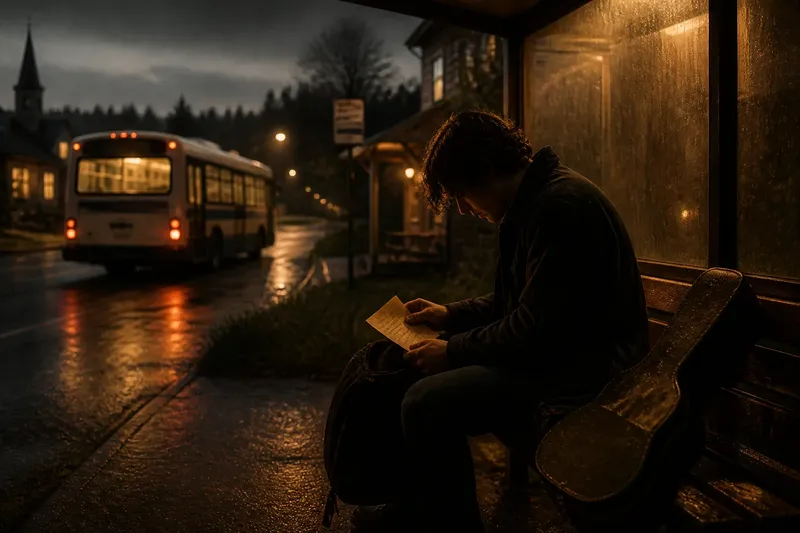
Say you are inventing a short drama about a musician who plans to leave a small town after a friend’s betrayal. The final scene reveals that the friend kept a letter the musician believed was lost. If the musician simply discovers the letter and the film ends, the surprise may be clear but the emotional consequence is not. If they read it, put it back in their bag, and still board the bus, the action shows that the discovery has changed the departure without erasing the hurt.
The scene does not need to tell us whether the musician will forgive the friend. It gives the audience an observable response and lets the uncertainty remain. That is often more affecting than adding another revelation merely to keep the story escalating.
Earned change is visible in choices
A strong ending often shows change, but change is not the same as a sudden declaration. A character who announces that they have become brave may not convince us. A character who takes an action they previously avoided gives us something concrete to consider.
To feel earned, that action should grow from the pressures and decisions the film has already shown. The ending may surprise us with the form a choice takes, but it should not make the choice feel imported from another story. If a guarded character finally asks for help, earlier scenes might have shown the cost of their self-reliance and the gradual formation of trust.
Change can also be small, partial or unwelcome. Someone might recognise a pattern without escaping it. Another character might keep a promise while losing the relationship they hoped it would preserve. The point is not that everyone improves; it is that the final action gives the audience grounds to understand what has shifted, or why it has not.
This is where surprise and earned change can work together. A character’s choice may be unexpected precisely because we thought we knew their limits. Yet the surprise becomes satisfying when the film has made the choice emotionally and dramatically plausible, even if it did not make the outcome obvious.
Why do some endings feel strong without a twist?
Can a predictable ending still be satisfying?
Yes. If the outcome fits the conflict and the characters’ choices, recognition can be satisfying in its own right. The pleasure may come from seeing a difficult decision made clearly, rather than from guessing incorrectly.
Does an open ending mean the story has no resolution?
Not necessarily. An ending can leave the future uncertain while bringing the present conflict to a meaningful point. Look for whether the film clarifies what the characters have decided, lost or become unable to avoid.
What makes a twist feel unearned?
A twist tends to feel unearned when it changes the story’s facts without growing from the information, motives or pressures already established. Ask whether the reveal reshapes the characters’ choices, or merely supplies a new fact after those choices have stopped mattering.
How can a group discuss an ending without arguing over the “right” interpretation?
Start with what everyone saw: a choice, a reaction, an object left behind or a conflict that remains unsettled. Then ask what each detail suggests, while leaving room for different readings of the same evidence.
Talk about the ending’s work, not just its surprise
In a post-film conversation, “Did you see that coming?” is an enjoyable question, but it can make prediction the whole test. Try asking what the reveal changed, what the characters did with the information, and which earlier moment looks different now. Those questions keep the twist in view without treating it as the only source of meaning.
You can also ask whether the ending gave the central conflict a clear new shape. If the story stayed open, what did it leave unresolved, and what did it settle? If a character changed, point to the action that made that change visible. Specific observations make room for disagreement without reducing the exchange to a verdict about whether the twist was clever.
For a quick reading, trace three things through the final stretch: what new information arrives, what consequence follows, and what choice or changed condition closes the film. They may happen in one scene or across several. If only the first is present, the ending may feel like a reveal waiting for its human meaning.
There is little value in treating every final scene as a puzzle to solve in advance. That habit can turn attentive viewing into a race to outguess the film, even when the story is asking you to notice a relationship, a cost or a choice. Letting the ending surprise you is not the same as demanding that it do so.
The most useful question is not whether an ending shocked you, but what you can now see that you could not see before. A twist may answer that by changing the past; a quiet decision may answer it by changing the future. When surprise, consequence and choice meet, the ending has more than a final trick to offer.